LED walls for boardrooms and conference rooms
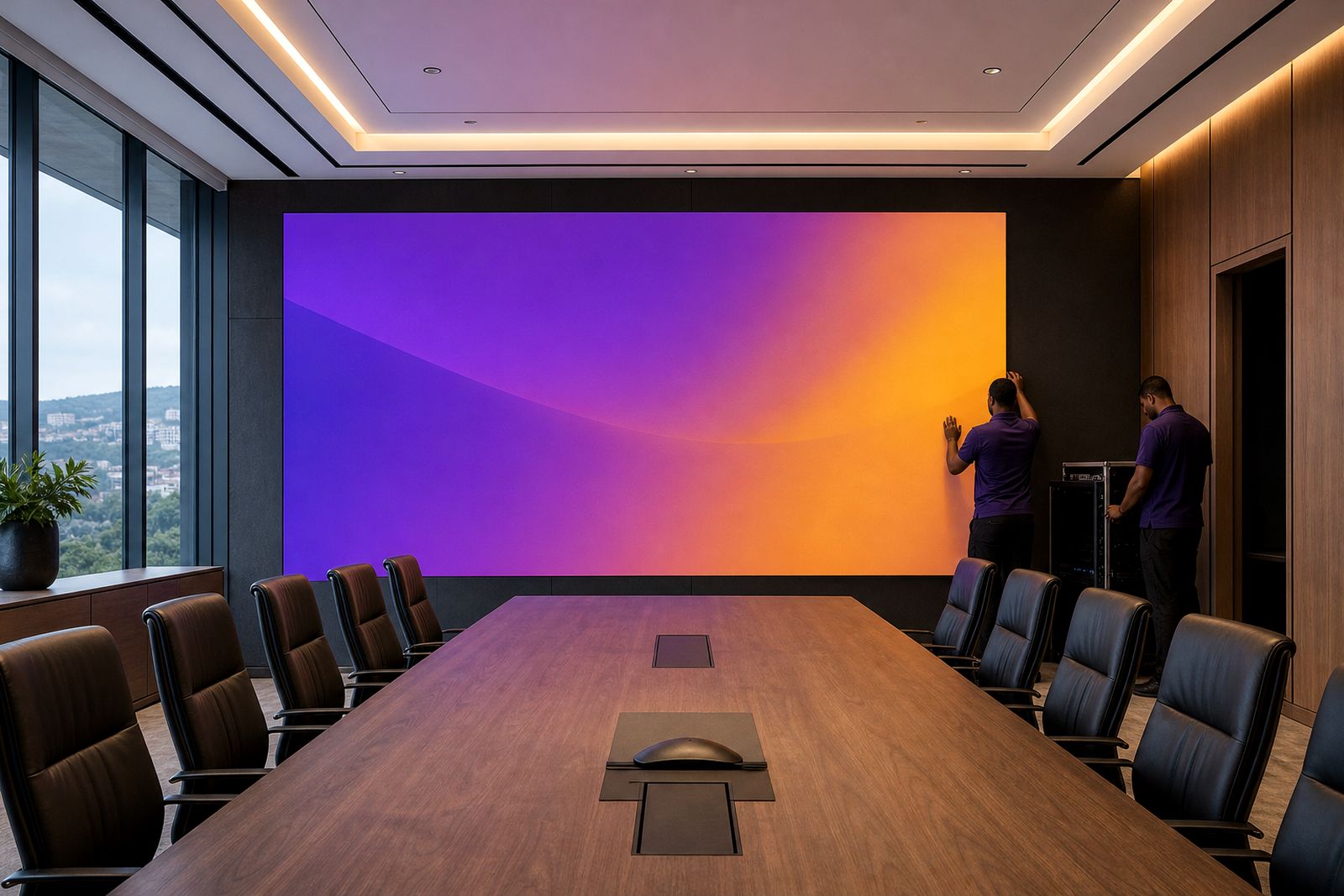
A single indoor LED wall can replace a washed-out projector image or a tiled row of large screens with one continuous canvas. In boardrooms and conference rooms, that change usually improves readability, room layout and day-to-day confidence during presentations.
When one wall solves three common room problems
Boardrooms often struggle with the same issues: blinds closed to fight glare, text that looks soft from the back row, and visible gaps between screens in a TV grid. A fine pitch indoor LED wall deals with those problems in a more direct way. The image holds up in brighter rooms, small spreadsheet text stays sharper at shorter viewing distances, and there are no bezels cutting through dashboards, video calls or presentation slides.
That matters in South African offices where boardrooms are asked to do more than one job. One room may host weekly management meetings, hybrid calls with remote teams, training sessions, sales reviews and client presentations. The display has to switch between camera feeds, slide decks, financial tables and brand visuals without the room feeling like a patchwork of add-ons.
- No central seam through shared screens or video conferencing layouts.
- Better visibility for detailed content such as CAD drawings, dashboards and spreadsheets.
- Less dependence on dimmed lighting during daytime presentations.
- A cleaner front wall when mounting frames, processors and cabling are planned properly.
Reading distance comes before panel size
The first question is usually wall size, but the more useful starting point is viewing distance. In a compact executive room in Randburg, a wall that looks impressive at the door can still be too coarse when someone sits 2 metres away. In a larger conference room, the opposite can happen: a very fine pitch wall may be more than the room needs, with budget being spent where viewers will not see the benefit.
Pixel pitch should be matched to the nearest seated viewer, the farthest seat, and the type of material shown most often. Boardrooms that lean on small text, data and shared laptop content usually need a finer pitch than rooms used mainly for keynote-style presentations. The wall proportion matters too. Many conference rooms work better with a wide format for video calls and side-by-side content, while some training spaces benefit from a taller layout.
- Measure the nearest and farthest seat, not just the wall width.
- List the real content mix: slides, spreadsheets, browser windows, camera feeds or signage loops.
- Allow for table position, ceiling bulkheads and sightlines around chairs.
- Check whether the room needs a flush finish or a framed front service structure.
A workshop example from a Gauteng meeting room
One recent workshop brief from a Gauteng office showed the usual pattern. The room had a projector, a long boardroom table and glass on one side. Morning light pushed the image flat, and the ceiling mount left people casting shadows whenever they stood near the front wall. The team also wanted hybrid meetings with a cleaner camera view behind the speaker.
After a site survey, the front wall was redesigned around an indoor LED installation with a processor, proper mounting structure and content input points near the table position. The wall size was set to fill the presentation area without forcing the lowest row of panels too close to the credenza line. Cable routes were shifted so the room stayed neat, and the processor location was planned for easy service access from inside the joinery area.
What changed was not only picture quality. The room worked better. Blinds were not being closed for every meeting, participants at the far end could read shared material more comfortably, and the camera background looked more professional on calls. Small details made a difference, like setting the wall height to keep sightlines clear over open laptops. It sounds minor but that is often where a boardroom install succeeds or fights the room every week.
What has to be planned with the room, not after it
An LED wall is only one part of the system. Boardrooms and conference rooms need the display, processing, mounting, power planning and source switching to behave like one installation. Retrofitting these items separately often leaves a good screen attached to an awkward room.
We look at the wall surface, ventilation path, service access and input sources before panel selection is finalised. Audio and conferencing gear may already be in place, so the new display has to sit cleanly with those systems. In many offices, municipal building rules and landlord conditions also affect drilling, cable containment and access times for installation teams.
- Wall strength and sub-frame fixing points.
- Power distribution and protected circuits for display equipment.
- Processor location with sensible cable runs from the table and rack position.
- Ventilation around equipment cupboards and enclosed joinery.
- Front access or rear access depending on the wall cavity available.
- Content playback needs for looping welcome screens or room branding between meetings.
Replacing a TV grid without keeping its compromises
Some companies move from a projector to a grid of large screens because it seems simpler at first. It can work for basic content, but the bezels become a constant limitation in boardrooms where people share diagrams, spreadsheets and video conferencing layouts. A speaker window landing across four panel edges is not a small nuisance when the room is used every day.
A smooth LED wall removes that interruption and gives more freedom in room design. You are not limited to the dimensions of standard televisions, and you do not need to build the whole front wall around fixed bezel lines. For executive spaces, briefing rooms and client-facing conference rooms, that cleaner result is often the point. It looks more considered, and it functions better under pressure.
This does not mean every room needs the finest available panel. The sensible route is to match pitch, wall size and processor capability to the work being done in that room. Some spaces need detailed, close-view performance. Others need a dependable presentation wall for larger groups with straightforward source switching.
Support matters once the room goes live
Boardrooms are not display showpieces that sit idle. They are working rooms, and support matters after handover. That includes calibration checks, panel servicing where needed, processor configuration and help with changes such as a new meeting table layout, extra input points or a room conversion from internal boardroom to client presentation space.
From our Randburg base we install across Gauteng and support indoor LED video walls in every province. For conference facilities with multiple rooms, it also helps to standardise control habits so users are not guessing from one room to the next. A boardroom wall should feel settled and predictable, not technical for the sake of it.
If you are weighing up a projector replacement or planning to remove a TV grid, send the room dimensions, seating plan and typical content mix through our contact form. That gives us enough detail to advise on the wall format, pitch range and installation approach that fits the space.
What our LED Video Walls customers say
Verified Google reviews
Questions we get asked
Are LED walls suitable for small boardrooms?
Yes, if the pixel pitch is selected for the nearest viewing distance. In smaller rooms the key is to avoid a panel pitch that is too coarse for people seated close to the wall.
Can an LED wall work with video conferencing systems?
Yes. Boardroom LED walls are commonly integrated with conferencing cameras, switching equipment and shared content inputs so presentations and remote participants can be shown cleanly on one screen.
Is an LED wall only for large conference venues?
No. Large conference rooms use them well, but many executive boardrooms and mid-size meeting rooms benefit from a smooth wall when they need better brightness, clearer detail and a neater front wall than a projector or TV grid can offer.
Also worth a look
Tell us about the job
Send sizes, materials and where you are through our contact form, and we will come back with the practical options.
Open the contact form