

Choosing a pixel pitch
Pixel pitch affects how smooth an LED wall looks at the distances people actually stand or sit. This guide turns that choice into a practical sizing exercise for boardrooms, retail floors, churches and venues.
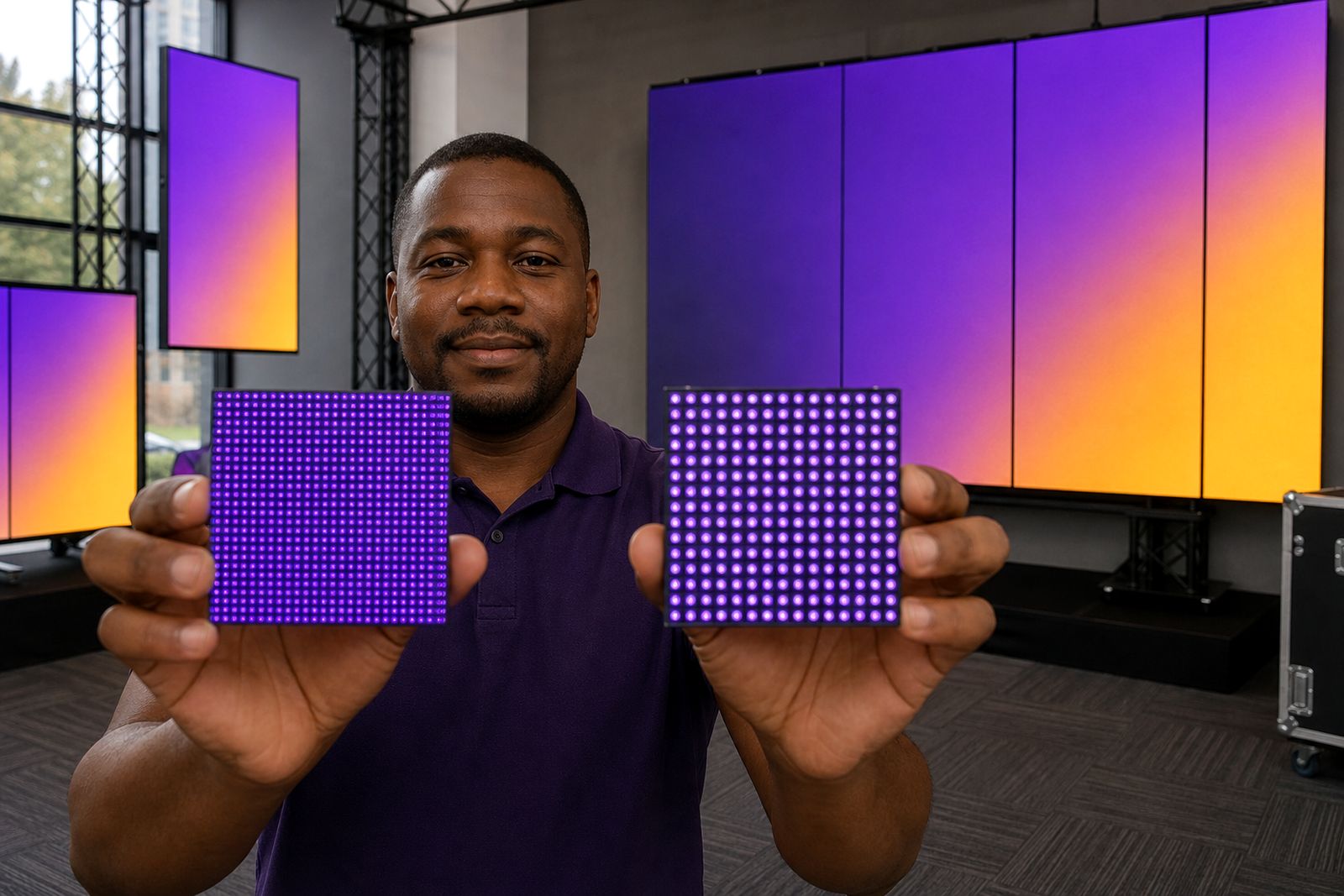
Start with the nearest viewer
The right pitch is usually decided by the person closest to the screen, not the person at the back of the room. In a boardroom that may be someone seated 1.8 to 2.5 metres from the wall. In a mall shopfront it may be a passer-by stopping right in front of the display. In a church or club the front row often sets the limit, even if most of the audience is much further away.
Pitch is the distance in millimetres between LED pixels. A smaller number means a tighter pixel layout and a smoother image at close range. A larger number suits longer viewing distances and larger walls, where the pixel structure is less noticeable. People often ask for the smallest pitch available, but that is not always the best use of the budget or the room.
- Measure the closest likely viewing point, not just the average seat.
- Note whether people will be seated, standing or walking past.
- Decide if the wall will show text, spreadsheets, brand graphics or live camera feeds.
- Check whether viewers will spend time near the wall or only glance at it briefly.
Use room type to narrow the range
Different spaces tolerate different pixel structures. A close-viewing boardroom presentation wall usually needs a finer pitch than a church side screen or a nightclub backdrop. Retail can go either way. A cosmetics store with price and product detail near the entrance may need a finer result than a large promotional wall seen from across an atrium.
As a working guide, finer pitch panels are commonly considered when viewers are under about 2.5 metres away. Mid-range indoor pitch often suits general conference rooms, churches and shops where most viewing happens a bit further back. Larger indoor pitch can still work very well for stage backgrounds, high mounting positions and venue branding where motion and impact matter more than tiny detail.
- Boardrooms and conference rooms: clarity for small text and faces matters.
- Retail counters and window-facing displays: close inspection is common.
- Churches and auditoriums: front row distance and song lyric size matter.
- Clubs and event venues: motion content can allow a less fine pitch.
- Studios: camera use needs careful planning because the wall may be viewed by lens as well as by eye.
Match the pitch to the content, not only the wall size
A large screen does not automatically need a fine pitch, and a small screen does not automatically get away with a coarse one. Content type changes the decision. PowerPoint slides with small text, dashboards, menus and product pricing ask more of the display than abstract motion loops. Faces on camera also reveal pixel structure quickly when people are close. If the wall will be split into several windows, each window becomes smaller and the need for a cleaner image usually increases.
This is where many projects drift off course. A venue may ask for a dramatic wall width but plan to use detailed sponsor slides. A retailer may want a narrow portrait wall near the till point, where customers are close enough to read every line. In both cases the pitch should be chosen around readability first, then around size. It saves rework later and the screen is easier to live with day to day.
Brightness, processor setup and source resolution also affect the result, but they do not cancel out a pitch that is too coarse for the distance. Good processing improves scaling and colour, yet the physical pixel spacing still shows if the audience is too close.
A quick measuring checklist for site visits
Before deciding on a panel range, gather a few room measurements and usage notes. We use these points on indoor wall projects in Randburg and across Gauteng, and they are just as useful for sites in Durban, Gqeberha, Cape Town or Polokwane. Ceiling height, reflections from shop glazing, and whether the wall sits in a narrow passage can all shift the recommendation a bit.
- Wall width and height available after finishes, trims and doors are considered.
- Distance from screen face to first row, first standing point or nearest walkway.
- Typical furthest viewing distance in the room.
- Ambient light from windows, skylights and internal lighting.
- Whether the wall will be landscape, portrait or a custom shape.
- How often small text, spreadsheets or menu boards will appear.
- Whether the wall is for permanent use or needs rental-ready handling.
- Access for mounting frames, processor location and service clearance.
Even one missing measurement can push a project towards the wrong pitch. A narrow boardroom with seating pulled close to the wall is very different from a deep training room, even if both want the same diagonal screen size.
Where people often overspend or underspec
Overspending usually happens when pitch is chosen as a status item rather than a viewing requirement. If the nearest viewer is several metres away and the wall is used mainly for large-format branding or presentation backgrounds, an ultra-fine pitch may not add much visible value. That budget may be better spent on a better mounting finish, content playback stability or room control integration.
Underspecifying happens when the wall is expected to carry detailed text at close range. This is common in boardrooms, control-style meeting spaces and premium retail interiors. The wall may look impressive from the door, but once people sit down the pixel pattern is obvious and small elements become tiring to read. In churches this can show up as lyrics that seem thick or ragged from the front blocks.
Another trap is using average distance alone. If nine out of ten viewers are four metres away but one presenter stands 1.5 metres from the wall every day, that presenter experience still matters. The same goes for a store where most shoppers pass by at two metres but staff regularly use the wall for close product launches or assisted selling.
Turn your notes into a shortlist
Once you know the closest viewing distance, room type and content style, the shortlist gets much smaller. At that point it helps to compare a fine pitch option and a more economical option at the planned wall size. The decision should consider image smoothness, text legibility, processor scaling and the physical look of the joins from normal room positions. It is not only about the panel spec sheet.
For indoor projects we can assess boardrooms, retail stores, malls, churches, studios and event venues, then recommend a pitch that suits the room rather than forcing the room to fit a stock answer. If you already have a wall size in mind, include the nearest viewing distance, the type of content and your town through our contact form. That gives us enough to guide the next step without wasting time.
What our LED Video Walls customers say
Verified Google reviews
Questions we get asked
Is smaller pixel pitch always better?
No. Smaller pitch helps when viewers are close or when the screen shows fine detail, but it is not automatically the right choice for every room. A longer-viewing-distance venue wall can perform very well on a larger pitch.
Can I choose pitch from screen size alone?
Not reliably. Two walls with the same size may need different pitches if one is in a boardroom with close seating and the other is in a church with a deeper room. Viewing distance and content carry more weight than size on its own.
Does a better processor fix a pitch that is too large?
A processor improves scaling, switching and overall presentation, but it cannot change the physical spacing between pixels. If the audience is too close, the pixel structure will still be visible.
Also worth a look
Tell us about the job
Send sizes, materials and where you are through our contact form, and we will come back with the practical options.
Open the contact form